An insert card is one of the cheapest touchpoints in a package and one of the easiest to get wrong. On a direct-to-consumer site the stakes are mostly aesthetic, but the moment the same card rides along in an Amazon shipment it becomes a compliance document, and a poorly worded one can get a listing suppressed or an account flagged for review manipulation. The good news is that the rules are specific and the fixes are cheap if you make them before the print run. Here are the mistakes that do the most damage and how to avoid each one.
Asking for the review the wrong way
The single most common violation is sentiment-gating, the card that says some version of “if you love it, leave us a five-star review.” Amazon’s policy treats any attempt to influence the outcome of a review, not just the fact of it, as manipulation. That includes asking only happy customers to post, routing unhappy customers to a support channel instead of a review, and offering any reward that is conditioned on leaving feedback. A neutral request is allowed and effective: language like “we’d value your honest feedback” or “share your experience” invites a review without steering it. The distinction sounds small, but it is exactly the line enforcement looks for.
Incentives are the second trap. You can include an Amazon coupon or a thank-you discount, but it cannot be tied to a review in any way, and it should not sit on the same line as the review request. Pairing “leave a review” with “get 10% off” reads as paid feedback even if you did not intend it that way. Keep the two asks physically and grammatically separate on the card.
Sending customers off Amazon
A card that points buyers to your own website to repurchase, or that captures an email address for a newsletter, runs into Amazon’s rules against diverting customers away from the marketplace. This is where QR codes get people in trouble. A QR code is not inherently a problem; the risk lives entirely in where it lands. A code that opens a warranty registration page, a how-to video, or a support hub is fine. A code that opens an email-capture form, an off-Amazon store, or a discount that only works on your own site is not. If you use a code, make sure the destination would survive a screenshot.
Contact information deserves the same scrutiny. Directing a customer to reach you through Amazon’s buyer-seller messaging is compliant; printing a personal email address or phone number to handle problems outside the platform is the kind of detail that turns a minor complaint into a policy case.
Treating an FBA insert like a DTC insert
If you sell through Fulfillment by Amazon, the insert has to be part of the manufacturer’s packaging before the shipment ever reaches a fulfillment center. Fulfillment staff will not add a loose card to a unit, and a stack of cards shipped separately does not get married to your inventory. Practically, that means designing the insert into the production process, printed and inserted at the factory or during your own prep, not as an afterthought dropped in a box. Sellers who plan the card late often discover the only compliant path is a full repackaging run.
Choosing a size that fights the package
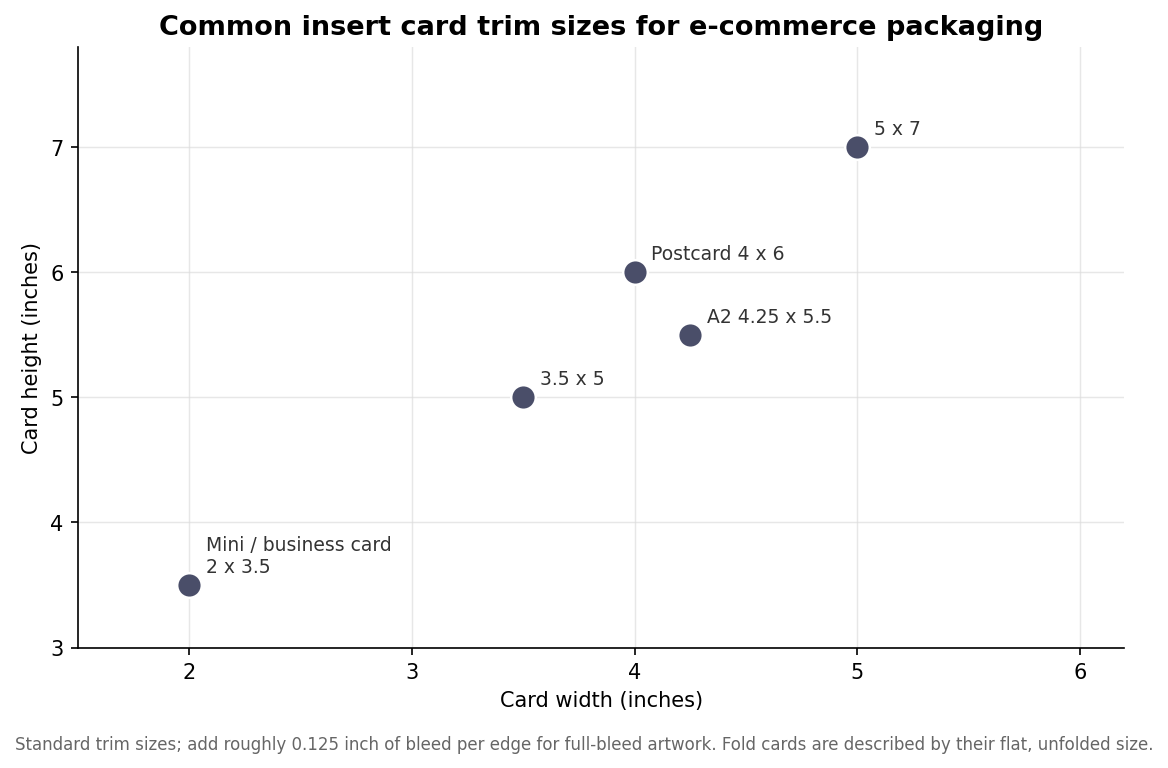
Physical mistakes are less dramatic than policy ones but still waste money. A card sized without reference to the box either rattles around or has to be folded to fit. Standard trim sizes exist for a reason: a 2-by-3.5-inch mini card tucks into small mailers and jewelry boxes, a 4-by-6 postcard suits apparel and mid-size cartons, and a 5-by-7 works for premium unboxing where the card is meant to be seen first. Whatever size you choose, add roughly an eighth of an inch of bleed per edge if the artwork runs to the trim, and describe fold cards by their flat, unfolded dimensions so the printer sets them up correctly.
Printing on stock that undersells the brand
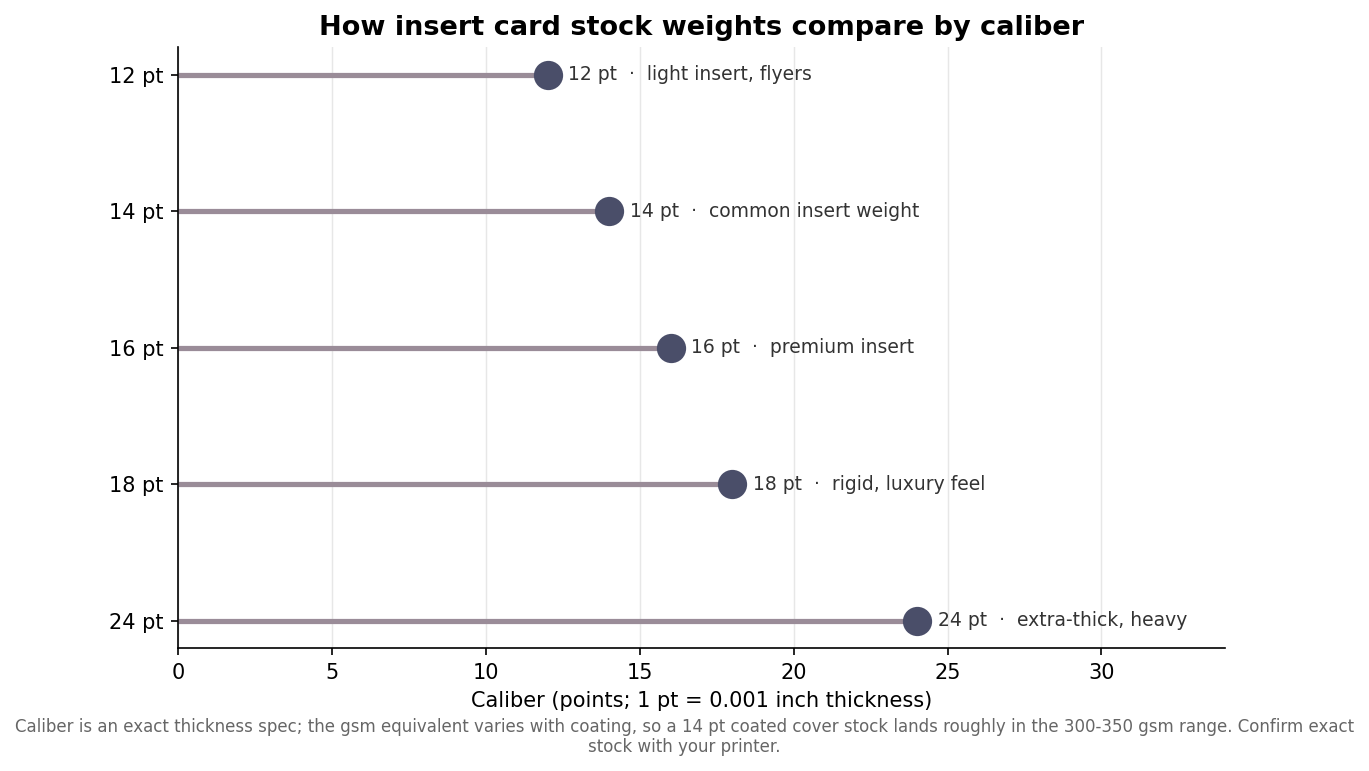
The card is a proxy for product quality, and a flimsy one sends the wrong signal in a moment, unboxing, when the customer is paying full attention. Card stock is specified by caliber in points, where a point is one one-thousandth of an inch of thickness. A 14-point stock is the common workhorse for inserts and feels substantially more solid than the 12-point used for throwaway flyers. Step up to 16 or 18 point when the card is central to the experience or carries foil or spot finishes that need a rigid base. The gsm equivalent shifts with coating, so treat point caliber as the reliable spec and confirm the exact stock with your printer rather than assuming a conversion.
Skipping the proof and the policy check
The last mistake is procedural: approving artwork without reading the words as a compliance reviewer would, and without checking a physical proof. Read every line and ask whether it tries to influence a review, offer a conditioned incentive, or pull the customer off-platform, and cut anything that does. Then check a printed proof for color, trim, and how the finish actually feels in hand, because a screen flatters a card that looks thin in person. A ten-minute review before the run is far cheaper than reprinting an order, or explaining an insert to Amazon after the fact.
Insert cards remain one of the highest-return pieces of print a brand buys, precisely because they arrive when the customer already has the product in hand. Keep the review ask neutral, keep the traffic on Amazon where the platform requires it, build FBA cards into packaging up front, and put the card on stock that matches the product, and the insert does its job without ever becoming a liability.
Leave a Reply